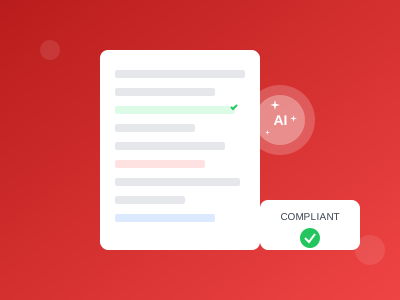
AI in home health is already practical: agencies use it to assist OASIS scoring and QA, support PDGM primary-diagnosis and grouping decisions, improve coding accuracy, flag documentation gaps, monitor patients remotely for readmission risk, optimize scheduling, and predict denials before claims go out. None of these replace clinicians or coders — they surface signals faster so your team spends time on judgment instead of chart-hunting. This guide walks through where AI genuinely helps a home health agency today and near-term, and how to adopt it without creating compliance risk.
Where AI Helps a Home Health Agency Right Now
The most useful home health AI is narrow and workflow-embedded, not a general chatbot. It reads structured and unstructured chart data, compares it against rules and historical patterns, and hands a prioritized worklist to a human. Below are the use cases with the clearest return.
OASIS scoring assistance and QA
OASIS accuracy drives both reimbursement and quality scores, so it is the highest-leverage place to apply AI. Under the current CMS timing rules, the Start of Care OASIS must be completed within five calendar days of the start of care, and recertification assessments fall in the last five days of the certification period — windows where rushed data entry produces errors. AI-based QA tools can cross-check functional items (Section GG), cognitive items, and diagnosis fields against the visit narrative and flag internal inconsistencies (for example, a functional score that contradicts the nurse's free-text note) before the assessment locks.
Because OASIS data feeds Home Health Value-Based Purchasing and public quality measures, a single miscoded functional item can quietly cost an agency across many episodes. AI catches the pattern; a clinician still makes the final call. Many agencies pair this with a formal coding & OASIS review so a credentialed reviewer signs off on what the tool surfaces.
PDGM primary-diagnosis and grouping support
Every 30-day period under the Patient-Driven Groupings Model begins by assigning the patient to one of twelve clinical groups based on the primary diagnosis, and that ICD-10-CM code must map to a valid group — otherwise the claim is a "questionable encounter" and won't group. AI coding-assist tools can read the referral, H&P, and physician documentation, then suggest a primary diagnosis that both reflects the main reason for home health and lands in a payable clinical group.
They can also surface secondary diagnoses that qualify for the comorbidity adjustment, which can raise the case-mix weight. The tool proposes; a coder validates against the documentation. If you want the mechanics behind the model itself, our PDGM guide breaks down groupings, timing, and comorbidity logic in plain language.
Coding accuracy and documentation / CDI
AI reads clinical notes at volume and flags where documentation doesn't support the codes — or where the codes undersell the patient's true acuity. This is the home health version of computer-assisted coding plus clinical documentation improvement (CDI). Realistic wins include catching unsupported primary diagnoses, missing comorbidities, and vague terminology that a physician query could resolve.
The goal is a defensible chart, not a higher bill. Agencies that treat AI output as the start of a clinical documentation review — not the end — get accuracy gains without inviting audit risk.
Remote patient monitoring and predictive risk
Predictive risk scoring is one of the more mature home health AI applications. By combining device data (weight, blood pressure, pulse oximetry), visit notes, and diagnosis history, models estimate a patient's near-term risk of hospitalization or readmission and rank the caseload so care managers intervene with the highest-risk patients first. This directly supports acute-care-hospitalization quality measures.
The caveat: a risk score is a prompt for a clinician to look closer, never an automated care decision. Keep a nurse in the loop and document the clinical rationale for any change in the plan of care.
Scheduling, visit optimization, and intake
Operational AI is lower-risk because it rarely touches clinical judgment. Routing and scheduling tools optimize visit sequences by geography, clinician skill mix, and visit windows — cutting drive time and reducing missed visits. On the front end, AI can parse inbound referrals and faxes, extract patient demographics and diagnoses, and pre-populate intake, shortening the gap between referral and Start of Care. Faster, cleaner intake also protects timely Notice of Admission filing (more on that below).
Denial prediction and revenue cycle automation
AI can score a claim's denial risk before submission by learning from your historical denials — flagging missing documentation, timing problems, or coding mismatches while there's still time to fix them. On the back end, it can auto-categorize denials by root cause so your team works the recoverable ones first instead of triaging blindly. This is where AI plugs directly into end-to-end revenue cycle management: fewer preventable denials up front, faster denial management on the back end.
Timing is a frequent denial driver in home health. The Notice of Admission must be submitted and accepted within five calendar days of the start of care; a late NOA reduces the 30-day period payment by 1/30th for each day of delay. AI intake and workflow tools help by surfacing NOAs approaching the deadline so nothing slips.
For a broader view of how these techniques fit together, see our companion pieces on how AI is transforming healthcare and AI in medical coding and RCM.
How to Adopt AI Responsibly
The agencies that succeed with AI treat it as a decision-support layer under human control, governed like any other system that touches protected health information.
Protect PHI and get the paperwork right
HIPAA does not prohibit AI, but any tool that creates, receives, maintains, or transmits PHI on your behalf is a business associate and needs a signed Business Associate Agreement. The HIPAA Security Rule requires appropriate administrative, physical, and technical safeguards for electronic PHI. Practical rules of thumb:
- Never paste PHI into a public consumer AI tool that lacks a BAA. If there's no BAA, there's no PHI.
- Confirm where data is processed and stored, whether it's used to train vendor models, and how it's encrypted in transit and at rest.
- Run a risk analysis for each AI system, the same as you would for any application handling ePHI. HHS's guidance on business associates is the baseline.
Keep clinicians and coders in the loop
Treat every AI output as a suggestion requiring human sign-off — especially for OASIS items, diagnosis assignment, and anything affecting the plan of care. A credentialed coder should approve coding suggestions; a clinician should approve clinical ones. This preserves accountability and keeps you defensible in an audit.
Validate before you trust, and avoid over-automation
Pilot any tool against a known sample: score a batch of past charts, compare AI output to your expert reviewers, and measure agreement before you rely on it. Monitor for drift over time and re-validate after model updates. Resist the urge to fully automate high-stakes steps — the right ceiling for most agencies is AI-suggested, human-approved. Used this way, AI compounds well with strong risk adjustment coding and disciplined healthcare data insights, rather than replacing the expertise behind them. For the technical background on how these systems actually work, our explainer on healthcare AI models is a useful primer.
Frequently Asked Questions
Is it HIPAA-compliant to use AI in home health?
Yes, provided you follow HIPAA's existing rules. HIPAA does not ban AI, but any AI vendor that handles PHI on your behalf must sign a Business Associate Agreement, and you must apply the Security Rule's administrative, physical, and technical safeguards. The safest practice is to never expose PHI to consumer AI tools that lack a BAA and to run a risk analysis for each system before deployment.
Can AI replace our coders or OASIS reviewers?
No. Today's home health AI is decision support, not a replacement for credentialed staff. It surfaces likely primary diagnoses, comorbidities, functional-score inconsistencies, and denial risks faster than manual review, but a coder or clinician must validate every output before it affects a claim, an OASIS assessment, or the plan of care. The best results come from AI-suggested, human-approved workflows.
What is the fastest ROI use case for a home health agency?
Denial prediction and OASIS QA usually pay off fastest. Catching a documentation or coding problem before a claim goes out is far cheaper than working the denial later, and correcting OASIS errors before lock protects both reimbursement and value-based purchasing scores. Both plug directly into an existing revenue cycle workflow without changing clinical care.
Medeoan helps home health agencies adopt AI-augmented RCM without sacrificing compliance — pairing coding and OASIS accuracy, documentation integrity, and denial prevention with credentialed human review at every decision point. If you want AI to make your team faster while a specialist still signs off, our end-to-end revenue cycle management team can help you build the workflow.