
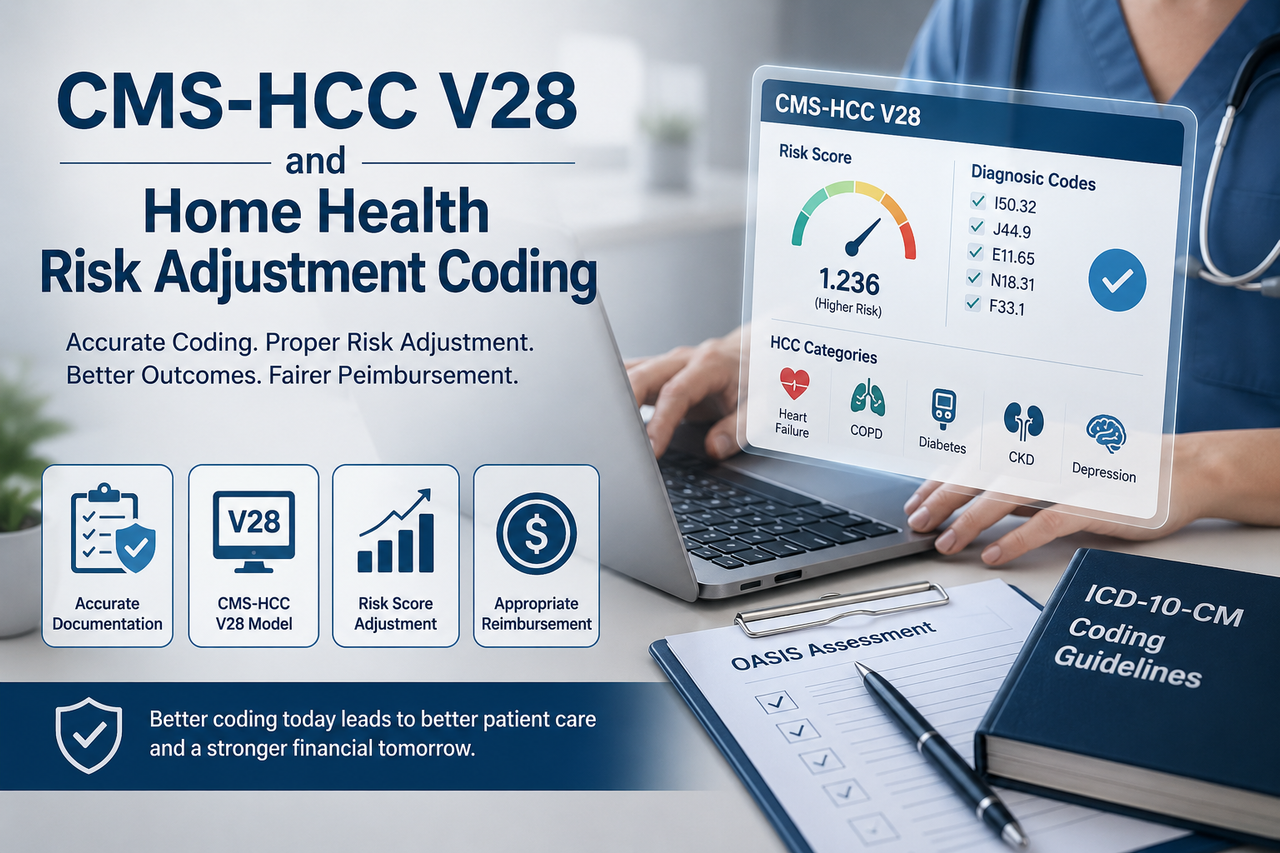
Most home health leaders first hear about the CMS-HCC V28 risk adjustment model from a payer relations email, a shared-savings statement that came in lower than expected, or a managed care partner asking why documentation "isn't holding up" the way it used to. If that describes your agency, you are not behind — you are exactly where the market is. The Centers for Medicare & Medicaid Services (CMS) has spent three payment years transitioning Medicare Advantage and many value-based arrangements from the older V24 model to V28, and 2026 is the year the transition finishes. The change is technical, but its consequences land squarely on the clinicians and coders who touch home health charts every day.
This guide is written from the home health agency's chair, not the health plan's. Most V28 explainers speak to Medicare Advantage (MA) plan actuaries and their internal coding teams. But agencies increasingly sit inside MA networks, accountable care organizations (ACOs), and other risk-bearing partnerships where accurate condition capture drives shared savings, network standing, and referral flow. When the model beneath those arrangements changes, your coding program has to change with it.
First, a Critical Clarification: HCC Is Not PDGM
Before anything else, one distinction prevents a lot of expensive confusion. Under traditional (fee-for-service) Medicare, your home health payment is set by the Patient-Driven Groupings Model (PDGM), not by CMS-HCC. PDGM uses clinical grouping, functional impairment level, comorbidity adjustment, admission source, and timing to build a 30-day case-mix weight. The CMS-HCC model is a separate risk-adjustment system that CMS uses to pay Medicare Advantage organizations and to calibrate benchmarks in many ACO and value-based programs.
So why should a home health agency care about V28 at all? Because a growing share of home health census is not fee-for-service. It flows through MA plans and through providers and networks that are themselves paid on risk-adjusted models. In those arrangements, the diagnoses your clinicians document and your coders capture feed the risk scores of the entities you contract with. Weak, non-specific, or missed condition capture translates into lower risk-adjusted revenue for your partners — and that pressure comes back to you through rates, referral decisions, and quality scorecards. Understanding V28 is how you stay a valued partner instead of a documentation liability.
What CMS-HCC V28 Actually Is
CMS periodically recalibrates the Hierarchical Condition Category (HCC) model that converts a beneficiary's diagnoses, age, sex, and eligibility status into a risk score. CMS refers to V28 as the "2024 CMS-HCC model" and to the prior V24 as the "2020 CMS-HCC model." You will see both naming conventions in payer communications, so it is worth memorizing the pairing: 2024 model equals V28, 2020 model equals V24 (see the CMS Risk Adjustment documentation at cms.gov).
The core mechanic is unchanged. Qualifying ICD-10-CM diagnoses map to Hierarchical Condition Categories, each HCC carries a coefficient, hierarchies suppress a less severe condition when a more severe related one is present, and the coefficients sum with demographic factors into a Risk Adjustment Factor (RAF) score. V28 keeps that architecture but rebuilds the clinical classification underneath it using newer data and a stricter view of which diagnoses reliably predict cost.
What Changed From V24 to V28
The V24-to-V28 transition is one of the most substantial risk-adjustment overhauls CMS has released. Four categories of change matter most for a coding program.
A Larger, Restructured Set of Condition Categories
V28 expands and reorganizes the underlying category structure. According to the CMS-HCC model documentation, the number of condition categories grows relative to V24 (widely reported as an increase from 86 to 115 payment HCCs), and the categories are renumbered and regrouped into revised disease families. Practically, this means the HCC number your team memorized under V24 frequently does not map one-to-one to V28. Crosswalks built for the old model are not reliable, and any internal reference sheet, encoder rule, or query template keyed to V24 HCC numbers needs to be rebuilt against the current model. Because these structural counts are exactly the kind of detail that gets misquoted, always confirm the current category list against the model files CMS publishes on its Risk Adjustment page.
Thousands of Diagnosis Codes Removed or No Longer Mapping to an HCC
V28 sharply reduces the set of ICD-10-CM codes that map to a payment HCC. The model documentation reflects a large net reduction in mappable diagnosis codes compared with V24 — commonly reported as a drop from roughly 9,800 codes to roughly 7,800, a net reduction of about 2,000 codes. The majority of what came out were unspecified and low-specificity codes that CMS determined did not reliably predict cost. For home health, where "unspecified" diagnoses have historically been common in referral documentation, this is the single most operationally important change: a diagnosis that carried risk weight yesterday may carry none today simply because it lacks the specificity V28 requires.
Constraining: Related Conditions Now Share a Coefficient
V28 formalizes constraining, where clinically related HCCs within a group are assigned the same coefficient so that adding more conditions in the group does not keep inflating the score. Diabetes is the textbook example. Under V24, diabetes with a complication such as diabetic peripheral neuropathy could contribute more to the RAF than uncomplicated diabetes. Under V28, the diabetes-family HCCs are constrained so that severity level within the family contributes more evenly — reducing the score "reward" for coding the complication separately, even though the complication still matters enormously for care planning and OASIS. Similar constraining logic applies across several condition families. The clinical takeaway: you still document and code the complication because it is clinically true and drives the plan of care, but you can no longer assume every added complication lifts the risk score the way it once did.
Recalibrated Coefficients and Removed Conditions
Beyond structure, V28 recalibrates coefficients throughout and removes or reduces the risk weight of several conditions that were significant contributors under V24. Categories touching certain vascular conditions, some diabetes complications, protein-calorie malnutrition, and specific chronic conditions saw weight reduced, removed, or absorbed into constrained groups. Because the direction and magnitude vary condition by condition, do not rely on rules of thumb — validate the specific coefficients and mappings for the conditions your patient population presents most often against the current CMS model files.
The Phase-In Timeline: Payment Year 2024 Through 2026
CMS did not flip from V24 to V28 overnight. It blended the two models over a three-year phase-in so plans and providers could adjust:
- Payment Year 2024: risk scores calculated as a blend of 33% V28 and 67% V24.
- Payment Year 2025: the blend shifted to 67% V28 and 33% V24. CMS described this as 67% of the risk score from the updated 2024 (V28) model plus 33% from the 2020 (V24) model.
- Payment Year 2026: the phase-in completes — CMS calculates 100% of the risk score using the 2024 CMS-HCC (V28) model.
CMS confirmed this final step in its 2026 Medicare Advantage and Part D rate materials, noting that CY 2026 is "the third and final year of the phase-in" and that risk scores will be calculated entirely on the 2024 model (see the CMS 2026 rate announcement materials at cms.gov). The reason the timeline matters to agencies: any softening effect the blend provided is now gone. In 2024 and 2025, a chart coded to old assumptions was partly cushioned by the residual V24 weight. In 2026 there is no cushion — the full V28 logic applies, so the gap between a specific, well-documented chart and a vague one is at its widest.
Where Home Health Agencies Sit in the Risk Adjustment Chain
Because agencies do not submit risk-adjustment data to CMS the way MA plans do, it helps to see exactly where your work enters the chain.
Medicare Advantage members on your census
When you serve an MA member, the diagnoses supported by your clinical documentation can flow — through the plan's data collection and provider records — into the beneficiary's risk profile. The plan is accountable for the accuracy of what it submits, but the quality of the source documentation originates with clinicians at the point of care, including in the home. Sloppy or non-specific documentation gives the plan nothing usable; precise documentation supports legitimate, defensible condition capture. This is why MA partners increasingly scrutinize agency documentation quality.
ACOs and shared-savings arrangements
If your agency participates in or feeds patients to an ACO, the benchmark those providers are measured against is risk-adjusted using CMS-HCC logic. Under-captured chronic conditions lower the risk score, which can lower the benchmark, which makes shared-savings targets harder to hit and can make a genuinely complex, resource-intensive patient look "cheaper" than they are. Accurate condition capture protects the whole arrangement — and your standing in it.
The OASIS-to-documentation-to-coding connection
Home health has a built-in advantage: the OASIS assessment already forces a structured, comprehensive clinical picture. The problem is the frequent disconnect between what the clinician assesses, what the narrative documents, and what finally gets coded. V28 punishes that disconnect harder than V24 did, because vague codes no longer rescue a weak chart. Tightening the OASIS-documentation-coding handoff is the highest-leverage move an agency can make. Our coding and OASIS review work exists precisely to close that gap between assessment and final code.
What V28 Means for Your Coding Program
The model change reshapes coding priorities in concrete ways.
Specificity is now the entire game
The clearest lesson of V28 is that unspecified diagnoses are a liability. When thousands of low-specificity codes stop mapping to any HCC, "diabetes, unspecified" or a vague circulatory code that once carried weight can now carry none. Coders and clinicians have to work from documentation that names the type, the manifestation, the laterality, the acuity, and the causal relationships. This is not up-coding — it is coding to the level of detail the clinical reality already supports but the documentation often fails to state. A disciplined risk adjustment coding program is built around eliminating unspecified codes wherever a more specific, documented diagnosis is true.
Chronic-condition recapture discipline
Risk adjustment resets every calendar year. A chronic condition documented last year does not carry forward automatically — it has to be re-documented and re-coded each year it remains active and relevant to care. Under V28's tighter mapping, gaps in annual recapture are more costly because there is less residual weight elsewhere to absorb the miss. Agencies serving risk-based populations need a systematic recapture process, not ad hoc catch-up.
Know your constrained and deleted codes
Every coding team working V28 populations should maintain a current, model-accurate reference for: (1) codes that no longer map to any HCC, (2) HCCs that are now constrained so severity within the group contributes more evenly, and (3) conditions whose coefficients dropped materially. Building this reference from the CMS model files — not from a V24-era cheat sheet — prevents both missed capture and false assumptions about which added conditions still move the score.
Use data to find the gaps
You cannot fix what you cannot see. Comparing documented and coded conditions across your risk-based census surfaces the patterns that matter: which unspecified codes still dominate, which chronic conditions are dropping out of annual recapture, which clinicians consistently under-document manifestations. This is where data insights turn a pile of charts into a targeted improvement plan, focusing clinician education and second-level review where the mapping actually breaks.
Building a V28-Ready Coding Program
Pulling it together, agencies operating in MA or value-based arrangements should treat V28 readiness as a program, not a memo:
- Rebuild references against the current model. Retire every V24-keyed crosswalk, query template, and encoder rule. Rebuild from the CMS-published model files.
- Attack unspecified codes at the source. Give clinicians point-of-care prompts that push for type, manifestation, laterality, acuity, and causal links so the documentation supports specific codes.
- Systematize annual recapture. Flag active chronic conditions for re-evaluation and re-documentation every year, tied to the assessment schedule.
- Add a risk-adjustment lens to OASIS and coding review. Second-level review should check not just PDGM case-mix accuracy but whether documented conditions are captured at V28-required specificity.
- Measure and educate continuously. Use analytics to find documentation and capture gaps, then feed the findings back into targeted clinician and coder education.
- Stay current with CMS releases. Model files, rate announcements, and implementation memos are updated on a predictable annual cycle. Someone on your team should own reading them the moment they publish.
Done well, this is not just compliance housekeeping. It makes your agency a stronger, more defensible partner to every risk-bearing entity you work with — the kind of partner that keeps and grows referral relationships because its documentation holds up.
Frequently Asked Questions
Does CMS-HCC V28 change how much Medicare pays my agency for fee-for-service episodes?
No. Traditional fee-for-service home health payment is governed by PDGM, not by CMS-HCC. V28 affects Medicare Advantage payment and the risk-adjusted benchmarks used in many ACO and value-based arrangements. It matters to your agency to the extent your census and contracts involve MA members or risk-bearing partners, because your documentation and coding feed their risk scores.
What is the difference between V24 and V28 in one sentence?
V28 (the "2024 CMS-HCC model") reorganizes and expands the condition categories, removes thousands of low-specificity diagnosis codes that no longer map to an HCC, formalizes constraining so related conditions share a coefficient, and recalibrates weights throughout — making documentation specificity far more decisive than it was under V24 (the "2020 CMS-HCC model").
When does the V28 phase-in finish?
The three-year phase-in completes in payment year 2026. Risk scores were blended 33% V28 / 67% V24 in 2024 and 67% V28 / 33% V24 in 2025, and in 2026 CMS calculates 100% of the risk score using the 2024 CMS-HCC (V28) model, per CMS's 2026 rate materials.
Why does the phase-in completion matter so much for 2026?
During the blend years, part of each risk score still came from the older V24 model, which softened the impact of vague or non-specific coding. In 2026 that cushion is gone. The full V28 logic applies, so the difference between a specific, well-documented chart and an unspecified one is at its largest.
Are "unspecified" diagnosis codes really a problem now?
Yes, more than before. V28 removed a large number of low-specificity codes from HCC mapping — the mappable code set shrank by roughly 2,000 codes, most of them unspecified. A diagnosis that once carried risk weight may now carry none purely because it lacks specificity. Documenting and coding to the specific, clinically supported diagnosis is the single highest-impact fix.
What is "constraining" and how does it affect diabetes coding?
Constraining means CMS assigns the same coefficient to clinically related HCCs so that adding more conditions in a group does not keep raising the score. For diabetes, V28 constrains the diabetes-family categories so severity within the family contributes more evenly than under V24. You should still document and code complications because they drive the plan of care and OASIS accuracy — but you can no longer assume every added complication lifts the risk score.
Do the V24 HCC numbers still map to V28?
Generally no. V28 renumbers and regroups categories, so V24-era crosswalks and cheat sheets are unreliable. Rebuild any internal references, query templates, and encoder rules against the current CMS-published model files rather than assuming a one-to-one mapping.
How often do chronic conditions need to be recaptured under V28?
Risk adjustment resets each calendar year, so every active, relevant chronic condition must be re-documented and re-coded annually — it does not carry forward on its own. Under V28's tighter mapping, missed annual recapture is more costly because there is less residual weight elsewhere to absorb the gap. A systematic recapture process is essential for risk-based populations.
How can a home health agency actually improve its risk-adjustment performance?
Rebuild references against the current model, attack unspecified codes at the point of care, systematize annual chronic-condition recapture, add a risk-adjustment lens to OASIS and coding review, and use analytics to find and close documentation gaps. Medeoan supports agencies with dedicated risk adjustment coding, integrated coding and OASIS review, and data insights that pinpoint where capture is breaking down.
Where can I verify the official V28 details myself?
CMS publishes the model files, category lists, coefficients, and payment notices on its Risk Adjustment page and in its annual Advance Notice and Rate Announcement documents at cms.gov. Because category counts, code counts, and coefficients are periodically updated, always confirm specific figures against the current CMS source rather than a secondary summary.